

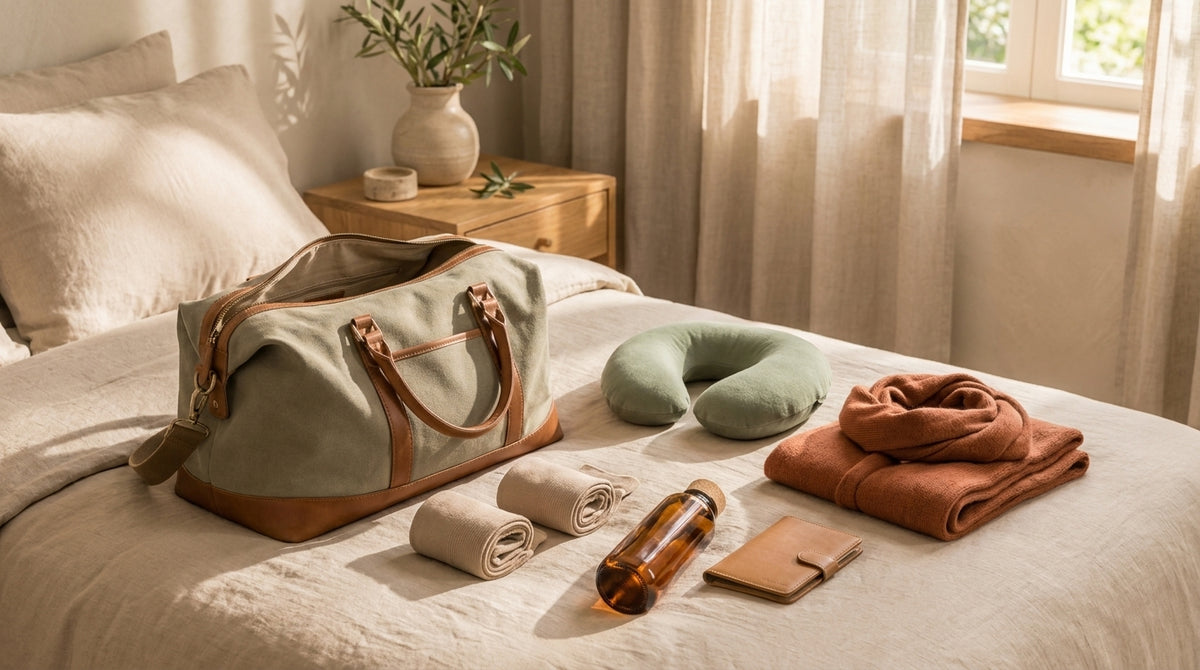
Long travel days demand a lot from your body. Between narrow airplane seats, crowded terminals, and hours spent sitting in rigid postures, your legs, lower back, and neck absorb significant strain before you even reach your destination.
Most travel packing advice focuses entirely on clothing, electronics, and toiletries. Yet the single factor that determines whether you arrive ready to enjoy your trip—or spend your first two days recovering from stiff joints and swollen ankles—is how thoughtfully you prepare for the physical reality of transit.
Building a travel comfort kit does not require bulky gear or complicated gadgets. With a handful of lightweight, research-backed essentials, you can maintain healthy circulation, protect your lower back, and step off the plane or train feeling refreshed.
Here is how prolonged transit affects your body, along with a practical packing framework designed for long journeys.
What Happens to Your Legs and Spine During Long Sitting
To understand why travel causes stiffness, it helps to look at the mechanics of prolonged sitting.
When you sit for four or more continuous hours, two distinct physical challenges occur:
- Venous Pooling in the Lower Extremities: Under normal circumstances, walking engages your calf muscles. Each contraction acts as a natural pump, compressing veins and pushing blood upward toward your heart against gravity. When you remain seated in a tight aircraft or train seat with your knees bent at a ninety-degree angle, that muscular pump stays dormant. Blood and interstitial fluid begin to pool in the tissues of your lower legs and feet. This fluid accumulation—known as dependent edema—causes that familiar heavy, tight feeling in your shoes by hour three. According to public health travel guidance from the Centers for Disease Control and Prevention (CDC), prolonged immobility during journeys of four hours or more significantly slows lower-leg circulation.
- Loss of Lumbar Lordosis: Standard transportation seats are curved concave to maximize cabin density. This forces your pelvis to tuck under and flattens the natural inward curve of your lower back (lumbar lordosis). Sitting in this slouched posture increases pressure on your lumbar discs by roughly fifty percent compared to standing. Over several hours, the muscles along your spine fatigue, leaving you with dull stiffness when you stand up to retrieve your carry-on luggage.
Understanding these mechanics makes packing straightforward. Every item in your comfort kit should either encourage fluid movement, provide targeted physical support, or reduce postural strain.
The Essential Travel Comfort Packing List
Pack these items in your personal item or carry-on bag so they remain accessible throughout your flight, train ride, or road trip.
1. Graduated Compression Socks (20–30 mmHg)
A pair of quality knee-high compression socks is the single most effective tool for long-haul travel. Graduated compression applies gentle, calibrated pressure that is tightest at the ankle and gradually eases toward the knee. This mechanical gradient supports vein walls and encourages venous return, preventing excess fluid from settling in your lower legs.
The clinical evidence supporting compression socks for long journeys is remarkably robust. A comprehensive Cochrane systematic review examining randomized trials of airline passengers on flights lasting at least four hours found that passengers wearing graduated compression stockings experienced substantial reductions in lower-leg swelling and reported significantly less transit discomfort compared to those who did not wear them.
When selecting compression socks for travel, look for:
- Knee-high length: Thigh-high garments are unnecessary for transit comfort and tend to roll down when sitting. Knee-high designs deliver pressure right where fluid pools.
- Graduated 20–30 mmHg pressure: This moderate level provides firm, supportive containment without feeling constricting.
- Open-toe design: An open-toe knit gives your toes natural breathing room inside travel shoes, prevents bunching in narrow footwear, and makes measuring calf fit easier.
Soothe Note
Put your compression socks on before you board, ideally at home while your legs are still rested. Trying to pull tight elastic socks over swollen calves in a cramped airplane lavatory is a frustrating chore you can easily avoid.
2. A Lumbar Roll or Inflatable Back Cushion
Most airline seats curve backward at the lower spine, offering zero support where your lower back needs it most. Carrying a compact inflatable lumbar cushion or a rolled travel towel restores your spine’s natural inward curve.
Position the support in the small of your back, just above your belt line. This small adjustment shifts your torso weight back onto your skeletal structure rather than straining your postural muscles. If you do not have a dedicated lumbar cushion, roll up a lightweight travel sweater or jacket into a firm cylinder about four to five inches thick.
3. Supportive Footwear with Quick-Adjust Closures
Tight, rigid shoes act like a tourniquet when feet naturally expand during altitude changes and prolonged sitting. Choose lightweight, supportive walking shoes with flexible uppers and adjustable closures. Avoid slip-on shoes with stiff, unyielding leather bands across the instep.
If you prefer an open-toe compression sock, you can comfortably wear your favorite walking shoes without worrying about seams pressing against your toenails during transit.
4. A Reusable Insulated Water Bottle
Cabin air on commercial flights typically operates at ten to twenty percent relative humidity—drier than most deserts. Dehydration causes your blood to thicken slightly, which further slows circulation through small capillaries.
Bring an empty stainless steel or BPA-free water bottle through airport security and fill it at a hydration station before boarding. Aim to sip four to eight ounces of water for every hour in transit. Limit alcohol and excessive caffeine, both of which accelerate fluid loss and disrupt restful sleep.
5. An Ergonomic Travel Pillow That Prevents Forward Head Drop
Traditional horseshoe-shaped beanbag pillows often push your head forward, creating neck tension instead of relieving it. Look for a low-profile memory foam travel pillow or a structured wrap that cradles your jaw and keeps your cervical spine aligned with your shoulders.
Your head weighs ten to twelve pounds when upright, but tilting it forward thirty degrees multiplies the load on your neck muscles to roughly forty pounds. Stabilizing your head allows your upper back and shoulder muscles to completely relax while resting.
4 Seated Micro-Movements for the Journey
Packing the right essentials gives your body passive support. Combining those tools with active micro-movements keeps your natural circulation active throughout the journey.
Perform this quick sequence once every hour without leaving your seat:
- Ankle Pumps (20 repetitions): Keep your heels on the floor and lift your toes as high as possible. Then raise your heels while keeping the balls of your feet planted. This rhythmic motion contracts your gastrocnemius and soleus muscles, activating the natural venous pump in your calves.
- Foot Circles (10 in each direction): Lift your feet slightly off the floor and trace slow, deliberate circles with your big toes. This lubricates the ankle joint and relieves tightness along the Achilles tendon.
- Glute and Thigh Squeezes (10 holds, 5 seconds each): Clench your gluteal muscles and press your thighs down into the seat cushion. Hold for five seconds, then release. This encourages blood flow through the deep pelvic and femoral veins.
- Seated Pelvic Tilts (10 repetitions): Gently arch your lower back away from the seat back, then slowly flatten your spine against the seat cushion. This micro-movement rehydrates spinal discs and eases stiffness across the sacroiliac region.
Whenever the seatbelt sign is off and aisle traffic is clear, stand up and take a two-minute stroll to the galley. Even sixty seconds of standing resets the pressure within your veins.
Soothe Note
If you have an aisle seat, use it to your advantage. Standing up for just one minute every ninety minutes restores normal vein diameter and resets spinal posture far more effectively than any seated exercise alone.
Post-Arrival Wind-Down: Resetting Your Body in 10 Minutes
When you finally arrive at your hotel or accommodation, resist the urge to immediately sit down on the hotel couch. Your body has spent hours compressed in a seated fold; it needs gentle extension and elevation.
Take ten minutes to complete this simple arrival ritual:
- Legs-Up-the-Wall (5 minutes): Lie flat on your back on the bed or a soft carpet, scoot your hips near the wall or headboard, and rest your legs vertically up against the surface. Gravity immediately assists in draining accumulated lymphatic fluid from your ankles and feet back toward your central circulation.
- Chest and Hip Opener (3 minutes): Place a rolled towel horizontally across the bed underneath your mid-back. Lie back and let your arms fall open in a gentle T-shape. This reverses the forward-slumped shoulder posture caused by airplane seats and luggage carrying.
- Gentle Hydration Walk (2 minutes): Drink a full glass of cool water and walk around the room at a relaxed pace. This reactivates joint lubrication and signals to your nervous system that transit is over.
Choosing the Right Travel Support
If you frequently notice swollen ankles, heavy legs, or fatigue after traveling, upgrading your transit gear makes an immediate, noticeable difference.
For reliable lower-leg comfort, our Open Toe Compression Socks (20–30 mmHg) provide firm, graduated support with a breathable toeless design that prevents crowding in travel shoes. Made with durable, soft-stretch yarns, they keep calves feeling light and energized across long flights and road trips.
To explore additional gentle tools for staying comfortable on the road, browse our curated SootheSage Body Support and Recovery Essentials. Every SootheSage order includes free standard shipping on orders over $50 and is backed by our 30-day money-back guarantee, so you can travel with complete peace of mind.
Reliable Sources & Further Reading
- Centers for Disease Control and Prevention (CDC): Blood Clots and Travel Risk Factors – Clinical overview of prolonged immobility during flights of four or more hours.
- Cochrane Database of Systematic Reviews: Compression Stockings for Preventing Deep Vein Thrombosis and Edema in Airline Passengers – Systematic review of randomized clinical trials evaluating graduated compression during long-haul flights.
- Cleveland Clinic Health Essentials: What You Need to Know About Compression Socks – Expert guidance on compression levels, graduated pressure, and travel circulation.
- Mayo Clinic Health Guidance: Foot Swelling During Air Travel: Causes and Practical Prevention – Practical recommendations for managing dependent edema and comfort during extended sitting.
- The SootheSage Guide: How Should a Knee Compression Sleeve Fit? Sizing and Care Basics – Our comprehensive guide to measuring and caring for compression knitwear.
- The SootheSage Guide: Long Car Rides and Lower Back Comfort: The 3-Point Driving Reframe – Practical seat setup and micro-break routines for extended road travel.


