

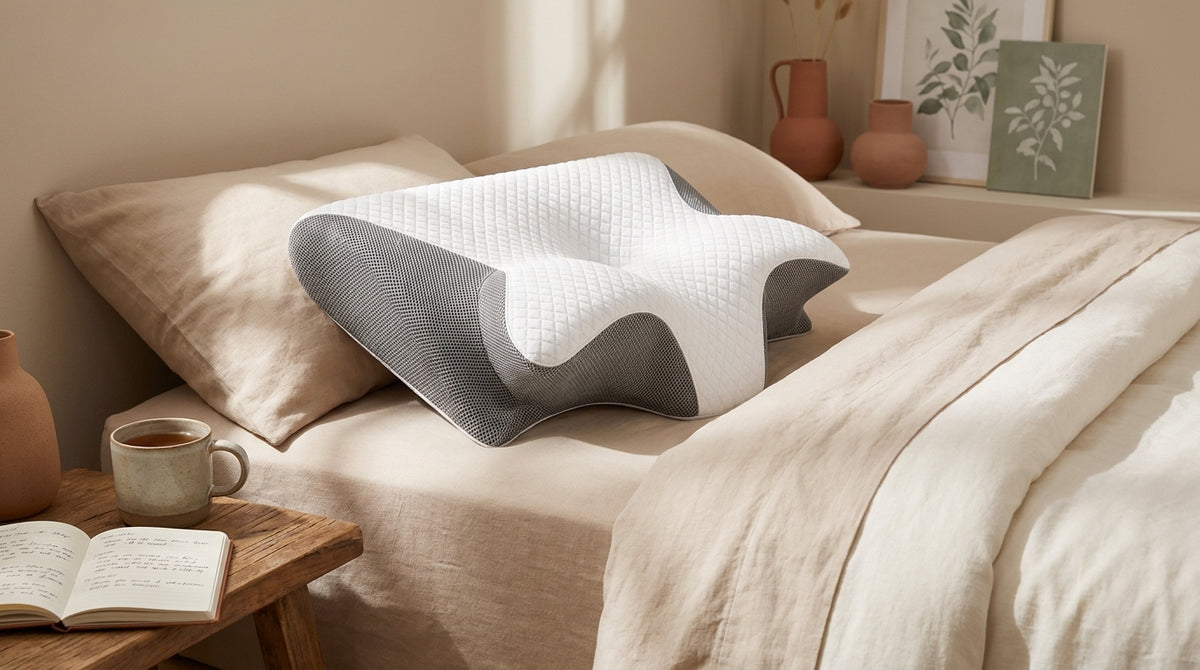
Waking up with a stiff neck or lingering shoulder tension is rarely an accident. When you sleep, your head rests against your pillow for seven to eight hours. If your pillow holds your head too high or lets it sag toward the mattress, your neck muscles spend the entire night contracted to keep your head steady.
Finding dependable neck comfort comes down to a simple mechanical principle: your cervical spine rests best when it maintains its natural curve and stays aligned with your mid-back. Because side sleeping and back sleeping create very different physical spaces between your body and the mattress, a single uniform pillow rarely fits both positions without thoughtful design.
Here is how pillow height, fill density, and sleeping posture work together to keep your neck comfortable throughout the night.
Why Sleeping Position Dictates Pillow Loft
In sleep ergonomics, loft refers to the uncompressed height or thickness of a pillow. Matching your pillow loft to your sleeping position ensures that your neck does not bend upward (flexion or lateral bend) or drop backward (hyperextension).
+-------------------------------------------------------------+
|              PILLOW LOFT BY SLEEPING POSITION               |
+-------------------------------------------------------------+
|  SIDE SLEEPING: HIGH LOFT (4 to 6 inches)                   |
|  - Bridges the entire gap between your ear & outer shoulder |
|  - Keeps cervical spine level and parallel to mattress      |
|  - Needs firmer, non-collapsing density                     |
|                                                             |
|  BACK SLEEPING: LOW TO MEDIUM LOFT (3 to 4 inches)          |
|  - Fills the cervical lordosis hollow behind the neck       |
|  - Keeps chin level with chest (avoids forward head thrust) |
|  - Best with shallow center cradle and supportive neck roll |
+-------------------------------------------------------------+
The primary difference between back and side sleeping is the distance between your neck and the mattress:
- When sleeping on your side, your pillow must bridge the entire width of your shoulder. The gap between your ear and the outer edge of your shoulder joint typically measures 4 to 6 inches, depending on your frame. If your pillow is too flat, your head tilts sharply toward the mattress, straining the muscles along the top side of your neck. If it is too tall, your head tilts upward toward the ceiling, compressing the cervical facet joints.
- When sleeping on your back, the back of your head is only 2 to 3 inches away from the bed surface. Your pillow only needs to cradle the hollow beneath your neck (the cervical lordosis) while allowing the back of your skull to rest comfortably. An overly tall pillow pushes your chin toward your chest, stretching the posterior neck muscles and narrowing your airway.
According to ergonomic research published in the National Center for Biotechnology Information (PMC8544534), pillow height plays a direct role in cervical curvature, muscular activity, and sleep quality. The researchers found that maintaining a neutral cervical angle significantly lowers pressure on the neck and helps prevent morning stiffness.
Soothe Note
If you often fold your arm under your pillow or bunch up the corner in the middle of the night, your pillow is likely too flat for your shoulder width. Your body is unconsciously searching for the extra height your pillow lacks.
The Side Sleeper Setup: Bridging the Shoulder Gap
Side sleeping is the most common adult sleeping posture. Clinical guidance from Harvard Health Publishing highlights that side sleeping is one of the kindest positions for spinal comfort, provided your neck stays horizontal and your head does not drop forward.
To achieve proper alignment on your side, focus on three specific elements:
1. Match Loft to Shoulder Breadth
A broad-shouldered person needs a taller pillow than someone with a narrower frame. When you lie on your side, have someone take a quick photo of your head from behind. Your nose, the notch between your collarbones, and your breastbone should form a straight, horizontal line parallel to the bed.
2. Seek Consistent Neck Support
Traditional down or polyester cluster pillows tend to shift under your head overnight. While they feel plush initially, the material displaces into the corners, leaving your neck unsupported by 3:00 AM. High-density molded memory foam maintains its structure, keeping your head level from the moment you turn off the light until morning.
3. Keep Your Hips and Knees Balanced
Spinal alignment does not stop at the neck. When your top knee drops forward onto the mattress, it twists your lower back and pulls your entire spine out of line. Placing a supportive pillow between your knees keeps your pelvis square, which reduces rotational strain through your thoracic and cervical spine.
The Back Sleeper Setup: Supporting the Cervical Hollow
Back sleeping naturally distributes your body weight evenly across the mattress surface. However, back sleepers often choose pillows that are far too thick, assuming a fuller pillow equals better luxury.
As noted by the Mayo Clinic's sleep ergonomics team, the goal for back sleeping is simple: keep your ears directly over your shoulders and your neck in neutral alignment with your chest.
When resting on your back:
- Look for a low to medium loft (3 to 4 inches): Your head should rest level, not propped forward. Your chin should point directly toward the ceiling, not tucked down toward your sternum.
- Choose a contoured neck roll or curved edge: A pillow with a raised lower border fills the hollow behind your cervical spine, allowing the back of your skull to nestle into a gentle center indentation. This supports the natural C-curve of your neck without forcing your head into an unnatural angle.
- Support your lower back: If you feel tension in your lower back while lying flat, placing a small pillow under your knees relaxes your hip flexors and allows your lumbar spine to settle naturally against the mattress.
Soothe Note
If you wake up with a dull tension headache at the base of your skull, your pillow may be tilting your chin down toward your chest. Lowering your pillow loft lets the suboccipital muscles relax overnight.
What If You Switch Between Side and Back?
Most people are combination sleepers. You might fall asleep on your back and wake up on your side, or shift positions several times throughout the night.
This creates a common sleep dilemma: a pillow high enough for side sleeping can crane your neck forward when you roll onto your back. Conversely, a low pillow perfect for back sleeping leaves your head dangling when you turn onto your shoulder.
There are two practical solutions for combination sleepers:
The Dual-Zone Contour Design
Pillows engineered with dual-height zones feature a gentle cradle in the center for back sleeping and elevated side lobes for side sleeping. When you sleep on your back, your head rests in the shallower center bowl. When you roll onto your shoulder, your head naturally moves onto the higher outer wing, keeping your neck straight without manual adjustment.
The Two-Height Reversible Edge
Pillows with a higher contour roll on one side and a lower roll on the other let you customize your baseline height based on your predominant position. Side sleepers with broader shoulders can sleep on the higher contour, while back sleepers or people with smaller frames can rotate the pillow 180 degrees to use the lower contour.
For combination sleepers who need adaptable support without guessing, an ergonomic option like the 2-in-1 Ergonomic Memory Foam Cervical Pillow Contour and Roll Sides provides two distinct resting heights. Its responsive CertiPUR-US foam cradles the curve of your neck while allowing you to rotate between heights depending on your body frame and preferred sleep angle.
If you are also refreshing your daytime sitting posture, pairing nighttime cervical support with a dedicated chair routine like the office chair lumbar placement guide or addressing morning stiffness causes helps protect spinal alignment around the clock.
4 Common Pillow Mistakes That Strain Your Neck
Before you replace your bedding, check whether one of these four everyday habits is contributing to your morning stiffness:
1. Stacking Two Standard Pillows
Stacking two flat pillows almost always creates too much bulk. Double pillows force the neck into extreme flexion when sleeping on your back and create an unstable, tilting surface when sleeping on your side. One properly contoured pillow provides far more stability than two stacked pillows.
2. Placing Your Shoulders on the Pillow
Your pillow is designed for your head and neck, not your upper back. Pulling your shoulders onto the pillow lifts your thoracic spine, flattening the cervical curve and defeating the purpose of ergonomic contouring. Your shoulder should rest flush against the bottom edge of the pillow, not on top of it.
3. Keeping a Pillow Past Its Usable Life
Pillows lose their structural resilience over time. Polyester pillows typically break down within 12 to 18 months, while quality memory foam maintains its density for 2 to 3 years. If your pillow no longer springs back when folded in half, it is no longer holding your head at the correct height.
4. Ignoring Mattress Firmness
Your mattress directly impacts how much pillow loft you need. On a plush mattress, your shoulder and hips sink deeper into the surface, which narrows the gap between your neck and the bed. On a firm mattress, your shoulder stays on top of the surface, requiring a slightly taller pillow to bridge the distance.
Soothe Note
Give any new pillow at least 3 to 5 nights. Your neck muscles and ligaments adapt to habitual postures over months, so settling into proper alignment can feel noticeably different for the first few evenings.
Simple Morning Neck Release: 60-Second Bedside Reset
If you do wake up with mild morning tightness, avoid sudden, forceful cracking or aggressive stretching. Gentle, slow movements help restore blood flow to resting muscles:
- Gentle Chin Tucks: Sit upright on the edge of your bed. Look straight ahead, then slowly glide your chin backward, as if making a subtle double chin. Hold for 3 seconds, release, and repeat 5 times. This lengthens the tight muscles at the base of your skull.
- Ear-to-Shoulder Glide: Gently lower your right ear toward your right shoulder without lifting your shoulder up. Hold for 5 seconds, breathing smoothly, then repeat on the left side.
- Shoulder Blade Squeezes: Roll your shoulders backward and down, gently drawing your shoulder blades together. Hold for 5 seconds, then relax. Repeat 3 times to open your chest and ease upper back tension.
Consistent comfort during sleep is not about finding an overly soft cushion. It is about giving your head and neck the steady, level foundation they need so your body can truly rest and recharge.


