

Propping your feet up at the end of a long day feels instinctive. Whether you have spent hours on your feet running errands or spent the afternoon seated at a desk, kick-starting gravity in the opposite direction brings instant relief.
Yet there is a clear difference between casually tossing your feet onto a low coffee table and elevating your legs in a way that actually aids venous circulation and relieves fluid heaviness. Done incorrectly, propping your legs on stacked bed pillows can bend your knees too sharply, pinch circulation behind the thighs, or strain your lower back.
Elevating your legs properly requires simple geometry: raising your feet and calves slightly above heart level, maintaining a soft bend in the knees, and supporting the lower back. Here is the science behind why elevation works, the exact height and angles to aim for, and how to build a comfortable 15-minute daily routine at home.
The Mechanics of Leg Elevation: Why Gravity Matters
Your circulatory system works tirelessly against gravity every minute you sit or stand. Oxygen-rich blood travels down from the heart through muscular arteries under relatively high pressure. Once that blood delivers oxygen and nutrients to your feet and calves, it must make the long journey back upward through your veins.
Unlike arteries, veins operate under low pressure. To push blood uphill toward the heart, your body relies on two main mechanisms:
- The calf muscle pump: When you walk or flex your ankles, your calf muscles contract and squeeze the deep veins, propelling blood upward.
- One-way venous valves: Tiny flap-like valves inside your veins open to let blood travel toward your heart and close to prevent it from sliding backward.
When you remain still for extended periods, the calf muscle pump shuts off. According to vascular reviews documented by the National Institutes of Health, prolonged upright posture increases hydrostatic pressure in the lower leg veins. Fluid begins to seep into surrounding tissues, creating that familiar end-of-day sensation of heavy, tight calves and puffy ankles.
When you elevate your legs above your heart, you invert the gravitational pull. Hydrostatic pressure in the venous system drops rapidly, allowing pooled blood and interstitial fluid to drain naturally back toward the central circulation. Clinical reviews in the Journal of Vascular Surgery demonstrate that elevating the lower limbs above heart level significantly reduces tissue fluid and promotes microvascular blood flow.
Soothe Note
You do not need to invert your body upside down or perform acrobatics to help your circulation. Elevating your feet roughly 6 to 10 inches above the level of your heart provides all the gravitational assistance your vascular system needs.
The 3 Alignment Rules for Proper Leg Elevation
Many people prop their feet up on a stack of couch cushions or an ottoman and wonder why their lower back begins to ache after ten minutes. Casual propping often creates unnatural pressure points. To get true circulatory relief without straining your spine, follow these three biomechanical rules:
1. Aim for 6 to 10 Inches Above the Heart
The goal is to let gravity work for you, not against you. Resting your feet on an ottoman keeps your legs below hip level if you are sitting upright, which does not reverse venous pooling. To achieve true elevation, recline your torso slightly or lie flat on your back, raising your feet and calves roughly 6 to 10 inches above your chest. This creates a gentle downward slope that encourages fluid drainage without forcing your cardiovascular system to work harder.
2. Maintain a 30-to-45-Degree Soft Knee Bend
Never lock your knees straight while elevating your legs. Propping your ankles on a high edge while your knees hang unsupported hyperextends the joint and compresses the popliteal vein behind the knee, which actually restricts blood return. Furthermore, keeping the legs rigid and straight pulls tight on the hamstrings and tilts the pelvis forward, flattening the natural lumbar curve. Your knees should always rest with a soft bend of roughly 30 to 45 degrees, fully supported from underneath.
3. Support the Thighs and Pelvis Continuously
Proper elevation supports the entire lower limb, from the heels up along the calves to the back of the thighs. When the transition from the mattress to the elevation surface is gradual, your lower back stays relaxed against the bed or floor. Sudden drops or unsupported gaps beneath the knees force your hip flexors to stay engaged, preventing your body from fully settling into rest.
Common Leg Elevation Mistakes to Avoid
Setting up a comfortable elevation space is straightforward, but small setup errors can cause muscle tension or defeat the purpose of the routine.
- The wobbly pillow tower: Stacking two or three loose bed pillows under your ankles is the most common mistake. Pillows compress unevenly, shift when you move, and leave the knee floating in mid-air. This focuses all the pressure on the Achilles tendon and lower calf while straining the knee joint.
- Elevating while sitting bolt upright: If you sit straight up at a 90-degree angle on a couch with your legs extended straight out on a table, your hip angle is deeply pinched. This sharp hip flexion can compress the femoral vein at the groin, restricting the very fluid return you are trying to encourage. Always recline your back to at least 110 to 120 degrees when your legs are elevated.
- Elevating too high or for hours on end: More height is not necessarily better. Inverting your legs straight up a wall at 90 degrees can strain tight hamstrings and pull on the sciatic nerve. For general relaxation and recovery, gentle 6-to-10-inch elevation above the heart is safer and far more sustainable than steep angles.
- Crossing your ankles: Keep your legs parallel and slightly apart. Crossing one ankle over the other creates localized pressure that can hinder blood flow in the resting leg.
Soothe Note
If your toes ever feel cold, numb, or start to tingle while elevated, your legs are either propped too high or your knees are hyperextended. Lower the elevation angle and ensure the backs of your knees are softly bent and supported.
The 15-Minute Evening Elevation Protocol
Consistency matters more than marathon sessions. Rather than trying to sleep with your legs propped up all night, a focused 15-to-20-minute relaxation routine in the late afternoon or evening yields noticeable comfort.
Clinical guidance from Healthline and wellness specialists at the Cleveland Clinic suggests that 15 to 20 minutes of supported elevation is optimal for assisting venous drainage and calming the nervous system.
Here is a simple step-by-step evening ritual to follow:
- Prepare your space: Choose a supportive surface, such as a firm mattress, daybed, or a comfortable yoga mat on the carpet. Avoid overly soft couches that cause your hips to sink lower than your spine.
- Position your support: Place a dedicated wedge pillow or structured support contour on the surface. If you are using pillows, arrange them in a stepped ramp rather than a single mound so your thighs and calves are supported together.
- Settle your lower back: Lie back with your head supported by a low pillow. Your head, neck, and shoulders should rest in neutral alignment without your chin being pushed toward your chest.
- Rest your legs: Slide your calves and feet onto the incline. Verify that your heels rest comfortably, your calves feel fully cradled, and your knees have a gentle bend.
- Practice diaphragmatic breathing: Close your eyes and take five slow, deep belly breaths. Inhale through your nose for four counts, expanding your abdomen, and exhale gently through your mouth for six counts. Deep diaphragmatic breathing creates gentle pressure changes in the thoracic cavity that further encourage venous return toward the heart.
- Rest for 15 to 20 minutes: Listen to an audiobook, read a chapter of a book, or simply close your eyes. When your time is up, gently bend your knees, roll to your side, and sit up slowly for 30 seconds before standing.
Choosing the Right Support: Pillows vs. Ergonomic Wedges
If you only elevate your legs once a month, adjusting two or three sturdy cushions can work for a quick rest. However, if daily foot fatigue, heavy calves, or post-activity soreness are part of your routine, a dedicated contour offers far better comfort and consistency.
Standard pillows shift out of place, flatten overnight, and leave gaps behind the knees. An ergonomically designed wedge provides continuous, firm support along the thighs, knees, calves, and heels.
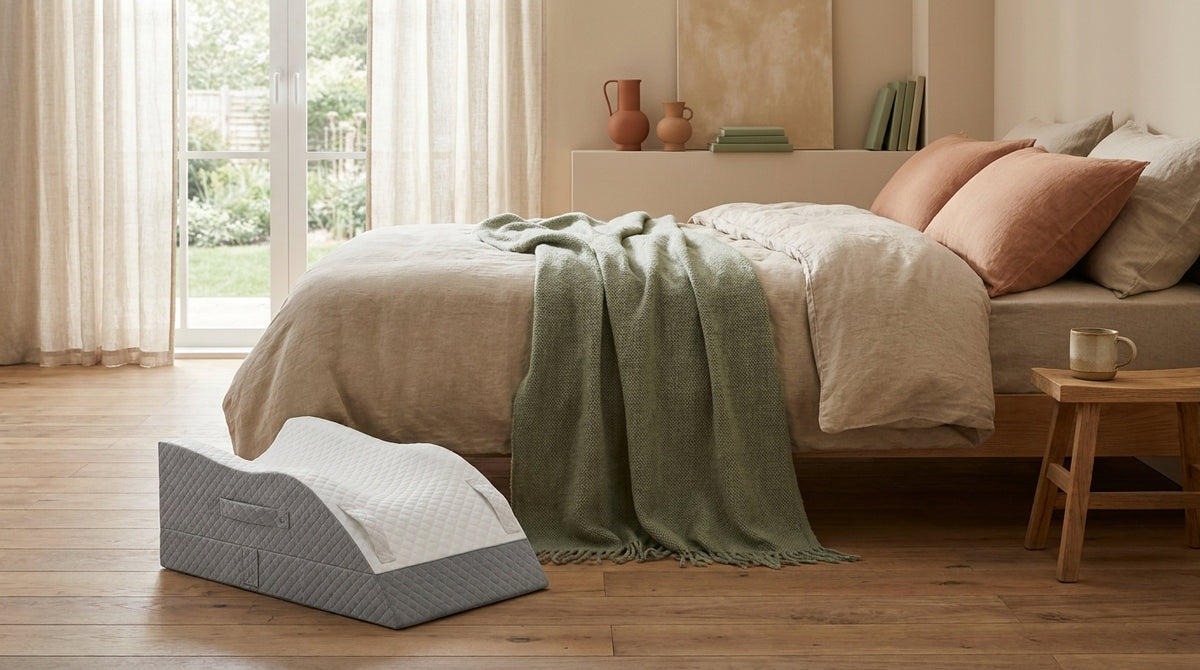
For structured, reliable positioning, the Memory Foam Leg Elevation Wedge Pillow uses high-density memory foam with an adjustable 6-inch and 9-inch elevation height. Its contoured cradle keeps legs resting parallel without slipping off the sides, and the dual-height design lets you choose gentle rest or deeper elevation depending on how tired your legs feel. Like all SootheSage comfort essentials, it includes free US shipping on orders over $50 and a 30-day money-back guarantee.
Frequently Asked Questions About Leg Elevation
Can I sleep all night with my legs elevated?
While some people enjoy sleeping with a slight leg elevation, you do not need to maintain the position all night. Shifting naturally during sleep is normal and healthy for your joints. A dedicated 15-to-20-minute session before bed is usually plenty to relieve daytime fluid accumulation so you can fall asleep comfortably.
How often should I elevate my legs during the day?
For everyday fatigue after work, gardening, or long walks, once an evening for 15 to 20 minutes works wonders. If your daily routine involves extensive standing or long periods seated at a desk, taking a short 10-to-15-minute elevation break in the afternoon and another in the evening can help prevent heaviness from building up.
Should I elevate my legs if I have circulation concerns?
Elevating the legs is widely recognized as a gentle, non-invasive way to assist venous circulation and ease end-of-day swelling. However, if you have diagnosed cardiovascular conditions, heart failure, or severe arterial disease where reduced blood flow to the feet could be problematic, always consult your physician for individualized guidelines on elevation height and duration.


