

How to Choose a Seat Cushion Shape (U-Cut, Donut, or Flat)
You can sit for hours and still feel like the chair is working against you. The seat is hard in the wrong places. Your hips slide forward. By mid-afternoon you keep shifting, standing, then sitting again with the same dull pressure.
A memory foam seat cushion will not fix a bad chair, a screen that sits too low, or a day with zero movement. It can change how pressure lands on your sit bones and the back edge of the seat. Shape matters as much as foam.
This guide walks through three common shapes: U-cut, donut (ring), and flat. You will leave with a simple pick, a two-minute fit check, and habits that help any pad work better.
Quick answer
| If you mostly want… | Start with… |
|---|---|
| Everyday desk, car, or home sitting with support under the sit bones and less load on the rear center of the seat | U-cut (open notch at the back edge) |
| A portable ring with an open center you can move chair to chair | Donut / ring |
| Extra loft and cushioning on a firm seat when you do not need a cutout | Flat pad |
No shape treats a medical condition. If sitting discomfort is new, severe, or comes with red-flag symptoms, talk with a clinician. For everyday comfort shopping, shape + fit + movement usually beat a thicker pad alone.
Why shape beats “thicker foam” alone
When you sit, a lot of your weight rests on the ischial tuberosities (sit bones) and the tissues under them. A chair that is too high, too hard, or poorly padded can leave feet unsupported, push you forward off the backrest, and stack pressure in one zone for hours. OSHA’s computer workstation guidance stresses a padded seat with a rounded front edge, height that lets feet rest flat (or on a footrest), and a backrest that supports the natural curve of the spine. Mayo Clinic’s office ergonomics guide adds the same core idea: support the spine, feet flat or footrest, then get up and move during the day. A cushion is a layer on top of that setup, not a substitute for it.
Cleveland Clinic notes that long stretches of sitting can leave the glutes under-used and the hips stiff. Their practical takeaway matches good desk habits: upright posture, feet flat, less leg-crossing, and regular stand-and-move breaks. A cushion helps with contact comfort. Motion keeps the rest of you happier.
Soothe Note: Buy shape for where you want less pressure. Buy foam density and cover quality for how long the pad stays even. Thick and soft is not always better if you sink until the chair pan still “punches through.”
The three shapes, in plain language
1. U-cut (rear cutout) seat cushions
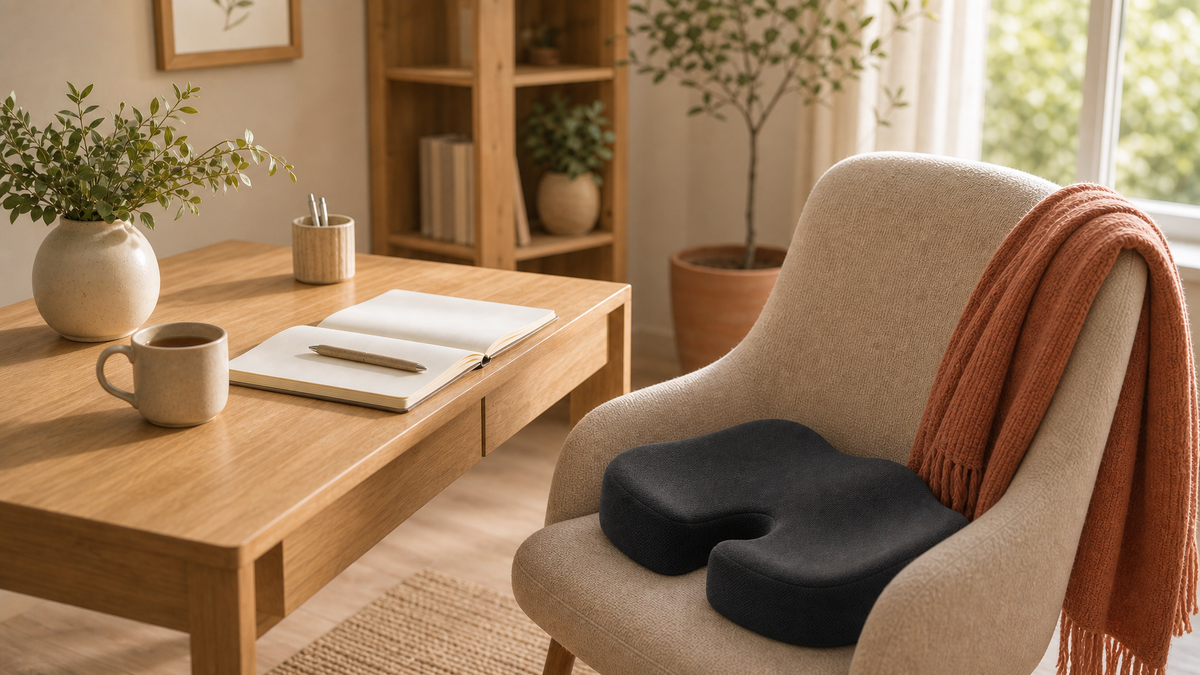
What it looks like: A mostly full seat pad with a U-shaped opening or notch at the back edge. Sit bones and thighs rest on foam. The rear center of the seat has less material under you.
Best everyday fit: Desk chairs, dining chairs, car seats, and long home sitting when you want a full platform under the hips with the open edge toward the back of the chair.
How to place it: Open U toward the backrest. Hips centered. If the cutout faces the room, you lose the design intent.
Patient-education sites that collect real-world sitting tips (for example coccyx.org’s cushion overview) often note that many people prefer a rear cut-out style over a full ring for day-to-day chairs. That is preference data, not a prescription. Your body and chair still decide.
Watch-outs:
- Too soft a foam on a very soft chair can still collapse; some people add a firm board under the pad on sagging seats.
- A pad that is too tall can raise your hips above a comfortable knee angle. Re-check feet and desk height after you add it.
2. Donut (ring) cushions
What it looks like: A ring or U-shaped ring with a clear open center. Weight rides on the rim.
Best everyday fit: Short-to-medium sits when you want the middle of the seat unloaded and a pad that travels easily between rooms or into a car.
How to place it: Center the opening under the area you want free of direct pressure. Stay centered so you do not roll off the rim.
Watch-outs:
- Rings can feel less stable than a full U-cut platform if you shift a lot or work at a slick chair.
- Traditional full “doughnut” styles were long sold for center pressure relief; many shoppers still prefer an open-back U for desk work. Try before you commit if you can, or use a clear return window.
3. Flat seat cushions
What it looks like: A solid rectangle or square of foam or gel-foam with no cutout.
Best everyday fit: Hard benches, firm dining chairs, or stadium-style seats when you mainly need loft and a softer top layer.
Watch-outs:
- A flat pad adds height and plushness but does not unload the rear center the way a cutout does.
- Very soft flat foam can bottom out; look for high-density foam that springs back after you stand.
Soothe Note: If your main complaint is “the chair is a plank,” flat can be enough. If your main complaint is “pressure right at the back edge of the seat,” start with U-cut or ring, not more flat foam.
A two-minute fit check (any shape)
- Chair first. Feet flat on the floor or a footrest. Hips level with or slightly above knees when you can. Back against the backrest. (OSHA chair tips; Mayo Clinic office ergonomics)
- Pad placement. U-cut: open edge to the backrest. Ring: centered. Flat: front edge slightly behind the chair’s front lip so it does not dig behind the knees.
- Sit test. Two minutes without crossing your legs. You should feel supported under the sit bones, not perched on a ridge or sliding forward.
- Stand test. Foam should rebound. A permanent deep crater means the foam is too soft or worn.
- Height check. If the pad lifts you so your feet dangle, add a footrest or choose a lower-profile cushion.
Desk, car, and home: same shapes, different jobs
Desk: Pair the cushion with screen height, keyboard reach, and a timer to stand. Cleveland Clinic’s sitting guidance points to about 20 minutes of standing or walking in each hour when you can, plus posture resets. A great pad on a terrible setup still loses by 3 p.m.
Car: Prefer a pad that stays put (non-slip base helps). Keep thickness modest so you still reach the pedals safely. Re-check mirror and seat distance after you add foam.
Home chair or couch edge: Softer furniture already sinks. A firmer U-cut or a board-under-cushion trick (from real-world sitting tips on patient education sites) can keep you from bottoming out. Donuts travel well from kitchen chair to office.
For a full desk setup pass, see our earlier guide: Your Desk-Day Lower Back Comfort Checklist.
Foam, cover, and base: the boring specs that matter
- Memory foam density: Higher-density foam holds shape longer under daily sitting. Soft “pillow” foam feels nice for ten minutes and flattens by lunch.
- Cover: Removable, washable covers earn their keep. Breathable fabric helps on long desk days.
- Base: A non-slip bottom keeps the pad from walking forward when you scoot into the backrest.
- Size: The pad should support most of the thigh without shoving into the back of the knee. OSHA’s seat guidance is useful here even when you add a cushion: support the thigh, leave a little space behind the knee, avoid a sharp front edge.
Movement still wins
A cushion changes contact. It does not replace motion. Build tiny defaults:
- Stand for calls when you can.
- Shift weight on purpose every so often.
- Walk to refill water on a schedule, not only when you remember.
If mornings feel stiff after long desk weeks, sleep position and pillow height play a role too: Why You Wake Up Stiff (Even After a Full Night’s Sleep).
Soothe Note: Think “cushion + chair setup + breaks” as one stack. Skipping any leg of the stool wobbles the whole day.
A simple decision tree
- Need less pressure at the rear center of the seat for long sits? → U-cut first.
- Need a portable open center and short multi-chair days? → Donut / ring.
- Need loft on a hard flat seat and no cutout preference? → Flat.
- Still unsure? Choose the shape that matches your longest daily sit (usually the desk), then test for a week with the fit check above.
If you want a U-cut pad for everyday chairs
When you want a full sit-bone platform with a rear opening, look for clear placement guidance (open U toward the back of the chair), a washable cover, and a base that stays put. SootheSage’s Memory Foam Seat Cushion with ergonomic U-cut is built for office, car, and home chairs with high-density foam, a washable cover, and a non-slip base. Place the open U toward the backrest, then re-check feet and screen height.
Prefer a portable ring with a center opening? The memory foam donut ring cushion is a lighter, move-around option in the same sitting-comfort family.
Free U.S. shipping over $50, and a 30-day money-back window if the shape is not your match. Questions: support@soothesage.com or (661) 545-6620.
Key takeaways
- Shape decides where pressure drops; foam quality decides how long the pad stays even.
- U-cut = rear open edge, strong everyday desk and car default for many people.
- Donut = open center, portable, less full platform.
- Flat = loft and softness without a cutout.
- Fit the chair first, then the pad. Move often.
- Comfort language only: a cushion is not a diagnosis or a treatment plan.
Sources
- Occupational Safety and Health Administration. Computer workstations eTool: Chairs. https://www.osha.gov/etools/computer-workstations/components/chairs
- Mayo Clinic Staff. Office ergonomics: Your how-to guide. https://www.mayoclinic.org/healthy-lifestyle/adult-health/in-depth/office-ergonomics/art-20046169
- Cleveland Clinic. Dead Butt Syndrome: A Real Pain (sitting, posture, movement tips). https://health.clevelandclinic.org/no-joke-your-desk-job-promotes-dead-butt-syndrome
- Coccyx.org (Jon Miles). Coccyx cushions and supports (cut-out vs ring preferences; practical sitting tips). https://www.coccyx.org/coping/cushions.htm


